From the Court to the Classroom: Why the Athlete Pathway Belongs in School & Community Sport
Over the past 30 years, I’ve spent time living inside athlete pathways.
From AIS and QAS programs, to elite junior basketball and rugby environments, one truth has never changed: performance is never just physical. The best athletes were always the healthiest, the best recovered, the most supported — and, often overlooked — the most cognitively engaged.
What has changed is our ability to finally prove the connection.
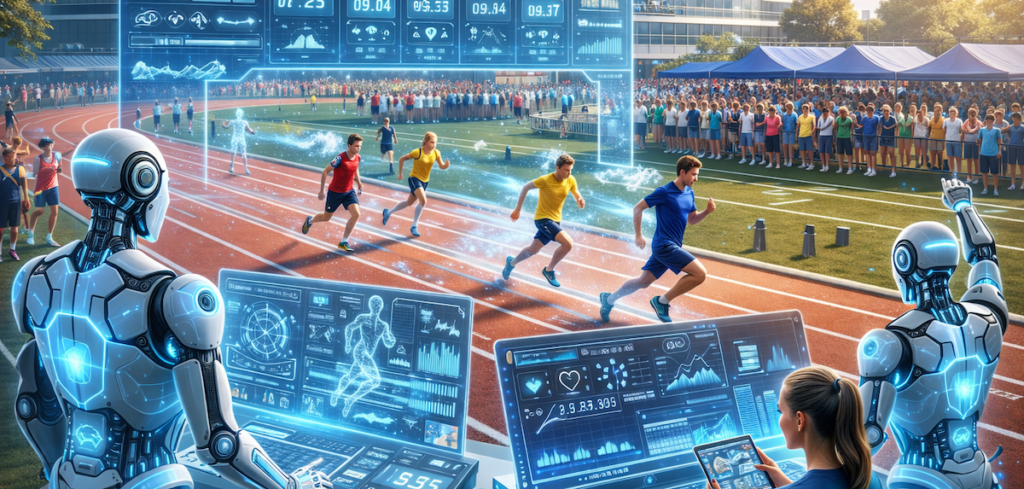
As we move deeper into AI-driven analytics and toward true Synthetic Intelligence (SI), AccelerWare is expanding the athlete pathway beyond elite sport. The next frontier isn’t just professional teams or academies — it’s schools and community sport, where the foundations of lifelong health, learning, and performance are built.
The Missing Link in School Sport
In Queensland, Physical Education is mandatory through Year 9.
Most schools already conduct basic standardised testing — the beep test, basic strength, mobility, and coordination assessments.
Yet today, those results are:
- Recorded once
- Looked at in isolation
- Rarely connected to wellness, recovery, nutrition, or academic outcomes
- Almost never used for early intervention
This is not a resource problem.
It’s a data architecture problem.
Schools are sitting on a powerful signal — they just don’t have the system to interpret it.
The Correlation We Can Now Measure
AccelerWare’s Athlete Pathway framework is built on long vertical data streams — tracking an individual over time, not just at a moment.
With AI today, and SI tomorrow, we can clearly highlight and predict the relationship between:
- Increased student athleticism & physical capacity
(strength, aerobic fitness, coordination, movement efficiency) - Improved wellness inputs
(sleep, recovery load, nutrition habits, injury history, stress) - Improved academic proficiency
(attention, memory, emotional regulation, attendance, engagement)
This isn’t theoretical.
Global research already shows strong correlations between physical literacy and cognitive performance. What’s been missing is a scalable, operational platform that allows schools to see it, monitor it, and act on it — without adding workload to teachers.
That’s where AccelerWare changes the equation.
Standardised Testing as an Early-Warning System
Imagine this:
- Every Year 7–9 student completes an annual beep test (already happening)
- Results are benchmarked against normative, age-based physical standards
- AccelerWare flags students who fall below expected physical development curves
- AI identifies patterns that correlate with:
- Poor recovery
- Inadequate nutrition
- Excessive fatigue
- Increased injury risk
- Declining academic engagement
This is not talent identification.
This is early health and wellbeing intervention.
Instead of waiting until:
- Behavioural issues emerge
- Academic performance drops
- Mental health challenges escalate
Support staff can proactively engage parents with objective, longitudinal evidence, not opinion.

A Holistic Intervention Model — Not a Performance Label
This is critical.
AccelerWare is not about labelling kids as “good” or “bad” athletes.
Our Athlete Pathway, when applied to schools and community sport, becomes a support framework, not a selection tool.
When a student falls below normative physical standards, the response isn’t:
- “Train harder”
It’s:
- “Are they sleeping enough?”
- “Are they fuelling properly?”
- “Are they carrying excessive fatigue or stress?”
- “Are they disengaged or overwhelmed?”
The data opens the conversation — human professionals deliver the care.
Teachers, PE staff, wellbeing coordinators, allied health providers, and parents finally operate from the same evidence base.
Scaling the Athlete Pathway Beyond Elite Sport
At AccelerWare, we’ve always believed the athlete pathway shouldn’t start at the elite level — it should start in the community.
The same framework we use to:
- Develop state and national athletes
- Manage rehab and return-to-play
- Optimise performance over long careers
…can be scaled to:
- Schools
- Local clubs
- Community academies
- Youth development programs
AI gives us pattern recognition.
Synthetic Intelligence will give us predictive foresight — understanding not just what is happening, but what will happen if nothing changes.
That’s how we shift from reactive systems to preventative, supportive ecosystems.
Why This Matters — Beyond Sport
If we get this right, the impact goes far beyond competition.
We create:
- Healthier students
- More engaged learners
- Better-supported families
- Reduced long-term injury and health costs
- Stronger community sport pathways
And most importantly, we stop treating physical development, wellbeing, and learning as separate silos.
They never were.
The Future Is Integrated
The future of human performance isn’t just about faster athletes.
It’s about better humans — physically capable, cognitively engaged, and holistically supported from childhood through adulthood.
At AccelerWare, we’re building the infrastructure to make that future measurable, scalable, and actionable — starting where it matters most: schools and communities.
The athlete pathway doesn’t end at elite sport.
That’s just where it becomes visible.
The real work starts much earlier — and now, finally, we have the intelligence to support it.
This article is part of our ongoing GM series exploring the future of human performance and the journey toward the world’s first Synthetic Intelligence platform for human movement. Each piece builds on the last — because performance, like people, is never developed in isolation.
Mike Hefferan
General Manager
Accelerware